
When Jesuits Baptize Socialism
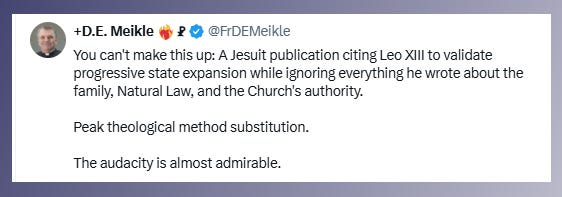
America Magazine weaponizes Leo XIII to sanctify what he explicitly condemned

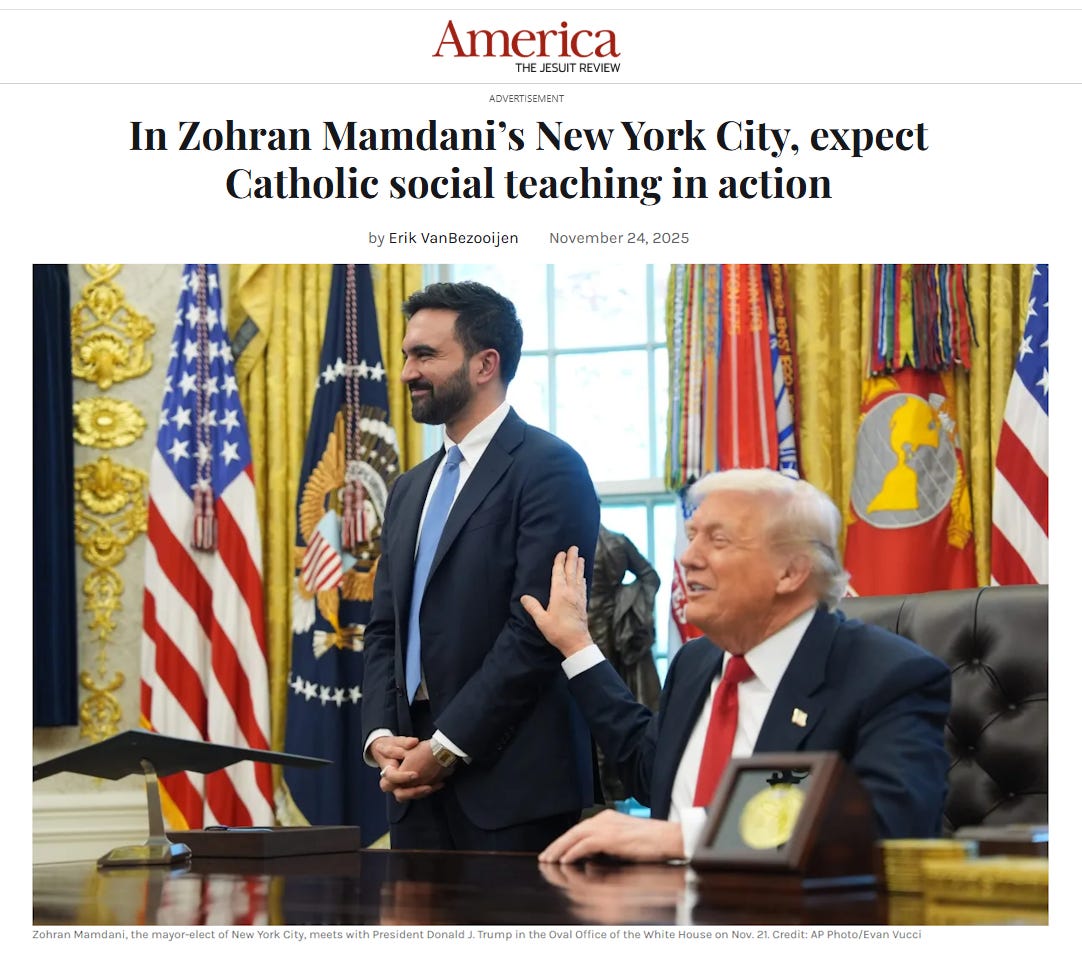
On Thanksgiving Day 2024, America Magazine, the flagship Jesuit publication in the United States, published a remarkable piece of theological legerdemain. Under the headline “In Zohran Mamdani’s New York City, expect Catholic social teaching in action,” author Erik VanBezooijen argues that New York’s newly elected socialist mayor embodies the vision of Pope Leo XIII’s foundational encyclical Rerum Novarum (1891).1
The audacity is breathtaking. The implications are worse.
The Claim
VanBezooijen’s thesis is straightforward: Mamdani’s platform: fare-free buses, universal childcare, rent freezes funded by progressive taxation; represents “Catholic social teaching in action” because Leo XIII also cared about workers’ welfare and advocated for state intervention on their behalf.
As VanBezooijen writes: “Mr. Mamdani’s economic policies are largely aligned with this aim. Far from seizing capitalist property, his affordability agenda...would accrue savings to working-class families, increase their purchasing power and protect them from being priced out of their homes and communities.”2
The article acknowledges that Mamdani’s positions on abortion and gender issues conflict with Church teaching, but suggests these are secondary concerns compared to his economic vision, which supposedly exemplifies what Leo XIII described as “the first and chief responsibility of government leaders: to act…with that justice which is called distributive—toward each and every class alike.”3
What Leo XIII Actually Taught
To understand the magnitude of this distortion, we must return to Rerum Novarum itself. Leo XIII was indeed responding to the Industrial Revolution’s upheaval and the suffering of the working class. But his solution was emphatically not what America Magazine suggests.
On Socialism
Leo XIII begins with an unequivocal condemnation: “The main tenet of socialism, community of goods, must be utterly rejected, since it only injures those whom it would seem meant to benefit, is directly contrary to the natural rights of mankind, and would introduce confusion and disorder into the commonweal.”4
He continues: “To suffer and to endure, therefore, is the lot of humanity; let them strive as they may, no strength and no artifice will ever succeed in banishing from human life the ills and troubles which beset it.”5 This is not mere fatalism, it’s a rejection of the utopian premise underlying socialist schemes: that human ingenuity can engineer away the permanent conditions of fallen human nature.6
On Private Property
Leo XIII grounds the right to private property not in positive law or economic pragmatism, but in human nature itself: “The fact that God has given the earth for the use and enjoyment of the whole human race can in no way be a bar to the owning of private property. For God has granted the earth to mankind in general, not in the sense that all without distinction can deal with it as they like, but rather that no part of it was assigned to any one in particular, and that the limits of private possession have been left to be fixed by man’s own industry, and by the laws of individual races.”7
This is crucial: private property is not a pragmatic arrangement subject to revision by majority vote or bureaucratic diktat. It flows from man’s rational nature and his need to provide for his family across time. As Professor Plinio Corrêa de Oliveira observed in his commentary on Leo XIII’s social teachings, the Pope’s defense of property was inseparable from his defense of the family: “The family is anterior to the State, and possesses rights which are prior to those of the State.”8
On the State’s Role
Leo XIII did indeed call for state intervention, but of a very specific kind. The state exists to secure the common good, which means protecting the rights and dignity of all classes, especially the vulnerable. But this is fundamentally different from redistributive schemes:
“The richer class have many ways of shielding themselves, and stand less in need of help from the State; whereas the mass of the poor have no resources of their own to fall back upon, and must chiefly depend upon the assistance of the State. And it is for this reason that wage-earners, since they mostly belong in the mass of the needy, should be specially cared for and protected by the government.”9
Notice what he’s not saying: He’s not calling for massive state programs that make workers permanent dependents. He’s calling for the state to protect workers’ natural rights, to form associations (unions), to receive just wages, to have reasonable working conditions, so they can become independent property owners.
He’s not calling for massive state programs that make workers permanent dependents.
On Subsidiarity
Leo XIII articulates what would later be formalized as the principle of subsidiarity: problems should be solved at the most local level capable of addressing them. He writes: “The State should watch over these societies of citizens banded together in accordance with their rights, but it should not thrust itself into their peculiar concerns and their organization, for things move and live by the spirit inspiring them, and may be killed by the rough grasp of a hand from without.”10
This is the opposite of Mamdani’s vision. Leo XIII wanted a pluralistic social order where families, parishes, guilds, and voluntary associations handled most social welfare. The state’s role was to support these mediating institutions, never to supplant them.
The Anthropological Divide
The deepest problem with America Magazine’s analysis isn’t economic; it’s anthropological. Leo XIII’s entire framework rests on a Christian understanding of human nature:
Man is made for family life - The family precedes the state and possesses natural authority over children’s education and formation;
Man needs property - Not for consumption, but for security and the ability to provide across generations;
Man is fallen - No political arrangement can eliminate suffering or create utopia; and
Man is made for God - Social order must recognize transcendent truth and the Natural Law.
As G.K. Chesterton observed in both Utopia of Usurers and The Outline of Sanity, the goal of Catholic social reform was never to make the proletariat comfortable, but to eliminate the proletariat entirely by restoring property ownership.11
Hilaire Belloc, writing in The Servile State, warned that apparent reforms which increased workers’ dependence on the state, even when materially beneficial, ultimately degraded human dignity by transforming free men into servile dependents: “The Servile State...proceeds from the acceptance of security from the possessing class by the proletariat in exchange for obedience and dependence.”12
The goal of Catholic social reform was never to make the proletariat comfortable, but to eliminate the proletariat entirely by restoring property ownership.
The Method Substitution
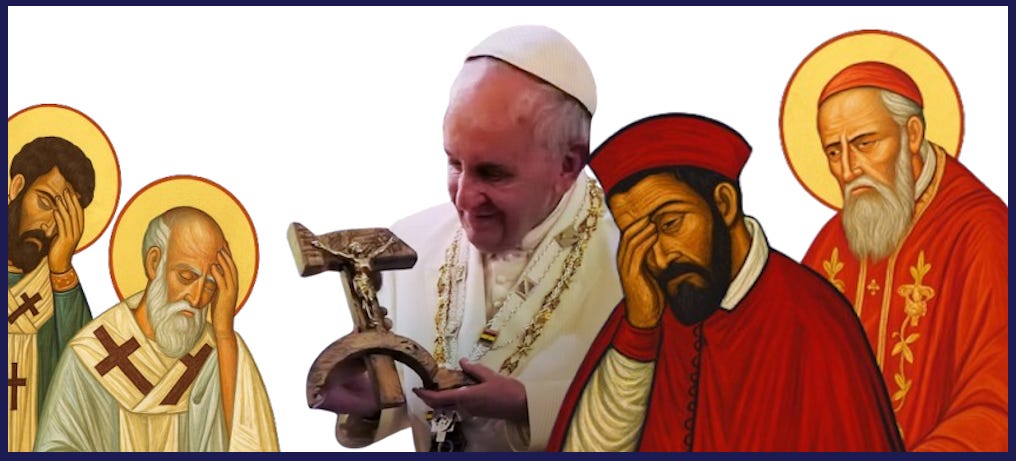
What America Magazine demonstrates is what I call “method substitution”; taking prestigious Catholic language while completely abandoning the metaphysical, theological, and social architecture that gave those terms meaning.13
Consider the term “distributive justice” which VanBezooijen invokes. For Leo XIII, operating within the Thomistic tradition, “distributive justice” means rendering to each what is due according to his nature, station, and contribution to the common good. It presupposes an objective moral order knowable through reason.
In contemporary “progressive”14 usage, “distributive justice” means engineering predetermined outcomes, usually equality of material conditions, regardless of individual merit, effort, or contribution.15 It presupposes that justice is whatever the democratic majority (or enlightened bureaucrats) declare it to be.16
These are incompatible concepts wearing the same verbal clothing. As Thomas Sowell observes in A Conflict of Visions, this represents the fundamental divide between the “constrained vision” (which recognizes permanent limitations on human nature and social engineering) and the “unconstrained vision” (which believes human reason can reconstruct society according to abstract ideals).17
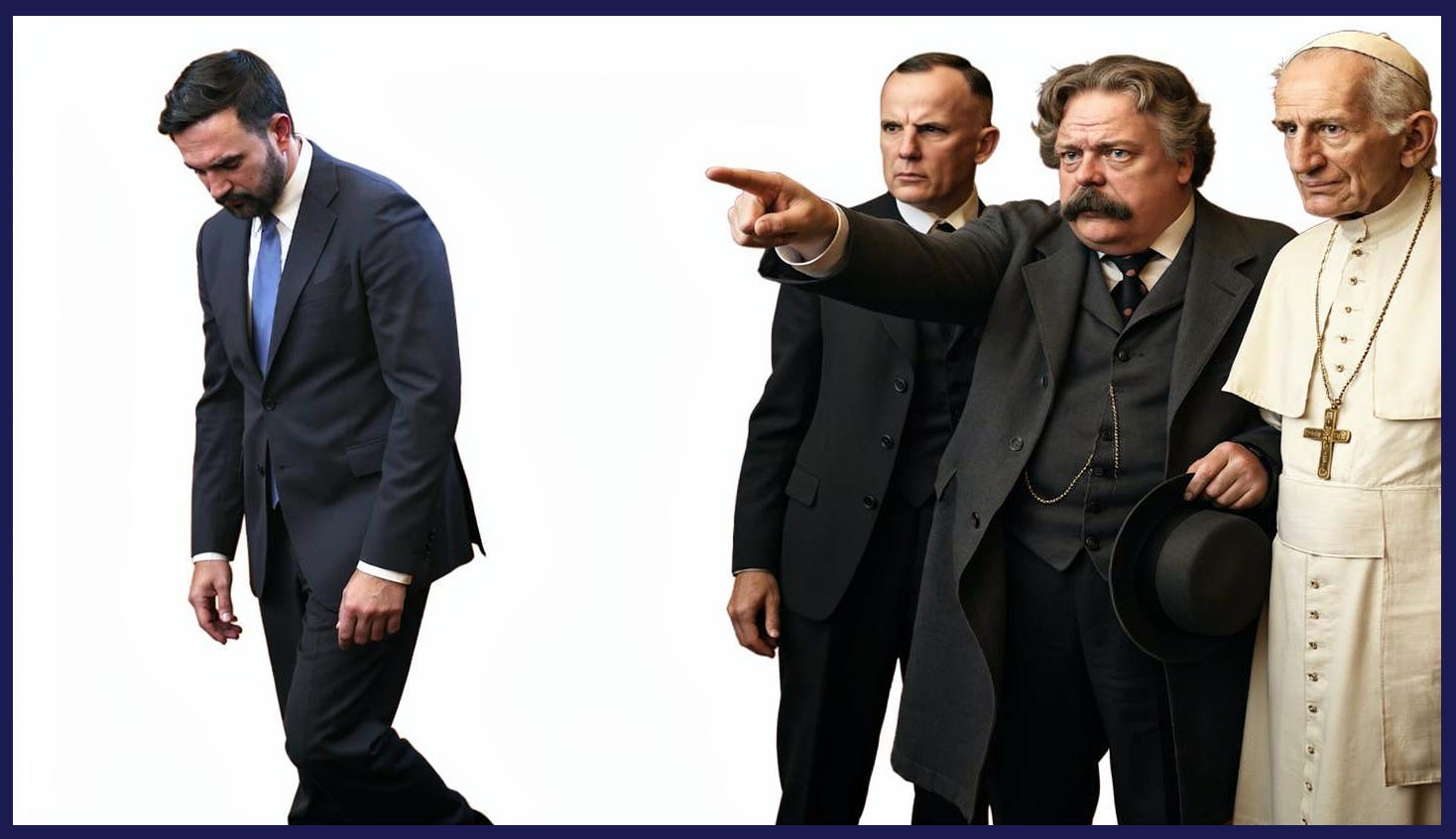
Leo XIII operated firmly within the constrained vision. Modern “progressives”, including those at America Magazine, operate within the unconstrained vision. Invoking Leo XIII’s language to baptize the latter is intellectual fraud.
What’s Actually Missing
Let’s be specific about what’s absent from Mamdani’s platform that Leo XIII considered essential:
1. The Family as Foundation: Leo XIII’s entire framework assumes the restoration of stable Christian family life. Mamdani’s positions on abortion and gender issues (which VanBezooijen dismisses as secondary)18 represent fundamental rejection of this foundation. You cannot build Leo XIII’s social order while dismantling the family;
2. Subsidiarity Properly Understood: Mamdani’s programs centralize provision in the state. Leo XIII wanted the state to protect families and voluntary associations so they could provide for their members;
3. Property Ownership: Leo XIII wanted workers to escape proletarianization by becoming property owners. Mamdani’s rent freezes and subsidies make them more comfortable as dependents19, not help them achieve independence;
4. Moral Formation: Leo XIII assumed a Christian social order where the Church had authority to form consciences. Nothing in Mamdani’s platform acknowledges transcendent truth or the Church’s teaching authority20; and
5. The Common Good Properly Conceived: For Leo XIII, the common good meant conditions where families could flourish, private property could be widely distributed, and the Natural Law could be recognized. For modern “progressives”, “common good” means whatever advances their policy preferences.
The Financial Interest
There’s one aspect of the America Magazine piece worth highlighting: buried in the article is the admission that Catholic Charities of New York recently “expressed concerns over federal cuts amounting to $11 million of its funding, most significantly affecting immigration services and food programs.”21
The article suggests Mamdani’s municipal spending could “prevent faith-based charities from becoming overburdened” by replacing lost federal funding.
This reveals a material interest lurking beneath the theological rationalization. For decades, Catholic institutions have become financially dependent on government contracts, particularly for immigration and refugee services. As this funding stream faces political pressure, publications like America Magazine discover that socialist politicians who promise expanded government spending suddenly “embody Catholic social teaching.”22
As Belloc warned in The Servile State, once institutions accept dependence on state funding, they inevitably become servants of state policy, regardless of what they claim to believe.23
The Jesuit Question
The fact that this comes from America Magazine, a Jesuit publication, is significant. The Society of Jesus was once the Church’s intellectual vanguard. Yesterday, as Dr. Anthony Stine documented in his Thanksgiving Day analysis of this very article, they function largely as “the Democrats at prayer.”24
This didn’t happen overnight. Father Malachi Martin’s controversial but extensively documented book The Jesuits (1987) traced how the order became deeply invested in liberation theology, essentially Marxist revolutionary theory baptized with Christian language, throughout Latin America in the 1960s and 70s.25
The same pattern repeats here: take Catholic authority (Leo XIII), strip away its metaphysical and theological content, and use the empty shell to sanctify contemporary “progressive” politics.26
Why This Matters
Some might ask: Why does it matter if a Jesuit magazine endorses a socialist mayor? Let them have their political preferences.
It matters because of how they’re doing it, by claiming their political preferences represent authoritative Catholic teaching while distorting what that teaching actually says.
This is precisely what I’ve called “McReligion” in other contexts: the reduction of robust theological tradition to therapeutic, consumerized spirituality that baptizes whatever the ambient culture already believes. When institutions that carry the prestige of Catholic authority use that prestige to mislead the faithful about what the Church actually teaches, they commit a profound injustice.
Young Catholics who read this article without formation in actual pre-conciliar Catholic Social Teaching will conclude that “being Catholic” means supporting “progressive” economic policies. They won’t know that:
Leo XIII explicitly condemned socialism;
Catholic teaching on property is grounded in Natural Law, not pragmatism;
Subsidiarity means empowering families and associations, not expanding state bureaucracy;
The family must be protected and privileged above all other social institutions; and
No economic program can be authentically Catholic if it rejects the Church’s moral teaching.
What Leo XIII Would Actually Say
If Leo XIII could respond to America Magazine’s appropriation of his teaching, I suspect he’d point to his other encyclicals that they conveniently ignore:
In Libertas Praestantissimum (1888), he warned against the notion that the state should be “godless” or neutral regarding truth: “Justice therefore forbids, and reason itself forbids, the State to be godless; or to adopt a line of action which would end in godlessness—namely, to treat the various religions (as they call them) alike, and to bestow upon them promiscuously equal rights and privileges.”27
In Immortale Dei (1885), he affirmed that: “The Almighty, therefore, has given the charge of the human race to two powers, the ecclesiastical and the civil, the one being set over divine, and the other over human, things.”28
This is the framework Leo XIII was operating within: a Christian social order where the Church had recognized authority and the state acknowledged transcendent Truth. To invoke his economic prescriptions while rejecting his entire vision of social order is like praising someone’s architectural blueprints while demolishing the foundation they were designed for.
The Real Catholic Alternative
The tragedy of the America Magazine piece isn’t just that it distorts Leo XIII. It’s that it obscures the actual Catholic alternative to both laissez-faire capitalism and socialist redistribution.
That alternative, articulated by Leo XIII and developed by thinkers like Belloc, Chesterton, and Corrêa de Oliveira, envisions:
Wide distribution of productive property among families, not concentration in either corporate or state hands;
Strong mediating institutions (families, parishes, guilds, cooperative societies) handling most social welfare;
Subsidiarity that empowers local solutions rather than centralizing power;
Recognition of Natural Law and the Church’s teaching authority in social questions; and
Primacy of the family as the fundamental unit of society, with parents possessing natural authority over their children’s formation.
This vision is neither Left nor Right in contemporary American terms. It challenges both the corporate consolidation that modern “conservatives” often defend and the state centralization that “progressives” advocate.
But you won’t learn about it from America Magazine. Instead, you’ll get baptized socialism with Leo XIII’s name attached; prestigious Catholic branding divorced from Catholic substance.
This is why formation in authentic Catholic Tradition matters. Not as nostalgia or preference, but as the only protection against those who would use the Church’s authority to advance agendas the Church herself has repeatedly condemned.
When Jesuits declare that a self-identified socialist who rejects Church teaching on marriage, family, and life somehow embodies Catholic social doctrine, we’re witnessing method substitution at its most brazen. The words remain Catholic; the reality they signify has been evacuated and replaced with something fundamentally alien to the Tradition.
Leo XIII deserves better. More importantly, Catholics seeking authentic social teaching deserve better than this sophisticated deception.
Read Rerum Novarum for yourself. Don’t take America Magazine’s word; or mine. Read what Leo XIII actually wrote. The difference between his vision and what’s being marketed in his name is the difference between solid food and cotton candy shaped like solid food. God bless and protect you, and thank YOU for your part in the restoration as we seek to bear Our Lord’s light to a world and churchmen who no longer believe.
Erik VanBezooijen, “In Zohran Mamdani’s New York City, expect Catholic social teaching in action,” America Magazine, November 24, 2025, https://www.americamagazine.org/short-take/2025/11/24/zohran-mamdani-socialist-catholic-social-teaching/ ; Barf.
Ibid.
Ibid.
Leo XIII, Rerum Novarum (1891), n. 4.
Ibid., n. 14.
John 12:8 (DRV), “The poor you have always with you: but Me you have not always.”.
Ibid., n. 8.
Plinio Corrêa de Oliveira, Revolution and Counter-Revolution (1959); cf. Pius XI, Divini Illius Magistri (December 31, 1929), n. 37.
Leo XIII, Op Cit. n. 29.
Ibid., n. 38.
G.K. Chesterton, Utopia of Usurers and Other Essays (London: Odhams) 1917; “The truth is, of course, that what we (rather clumsily) call Capitalism ought to be called Proletarianism. The point of it is not that some people have capital, but that most people only have wages because they do not have capital.”
Hilaire Belloc, The Servile State (1912); “The Servile State is that state of society in which the proletariat shall have exchanged its liberty for security, and shall have become a servile population working under the direction of the owners of the means of production.”.
This technique of preserving traditional terminology while evacuating and replacing its content is not unique to “progressive” Catholic circles; it represents a broader pattern in modern ideological discourse. The political Left has long understood that it’s easier to capture prestigious language than to argue against it directly. As Thomas Sowell observes in A Conflict of Visions, terms like “justice,” “rights,” and “equality” function as “question-begging words” that create the illusion of continuity while smuggling in fundamentally different concepts. Michel Foucault argued that power operates through discourse, and capturing authoritative language allows one to define reality itself. Gramsci advocated for the “long march through the institutions,” recognizing their defilement requires not only aquiring positions of power but the language of legitimacy.
The term “progressive” is itself a masterpiece of linguistic fraud. It presumes what it should prove; that the direction of travel represents progress rather than regression, advancement rather than corruption. To call oneself “progressive” is to claim the future, to position one’s opponents as obstacles to inevitable improvement rather than defenders of permanent Truth.
2 Thessalonians 3:10 (DRV); “if any man will not work, neither let him eat”.
Barf.
Thomas Sowell, A Conflict of Visions: Ideological Origins of Political Struggles (1987).
This is the poisoned fruit of the “seamless garment” approach articulated by Cardinal Joseph Bernardin in the 1980s: by treating all issues as morally equivalent, it renders the Church incapable of moral clarity on anything. A politician who supports the direct killing of innocent children in the womb but proposes higher taxes on the wealthy is deemed more “Catholic” than one who protects life but questions government childcare programs. The Church thus becomes a reliable auxiliary of one political faction; coincidentally, the one that promises funding for Catholic Charities, while abandoning her prophetic witness on the matters where her teaching is clearest and most desperately needed. As the saying goes: when everything is equally important, nothing is actually important. The “seamless garment” doesn’t protect the naked; it smothers moral discernment.
Thomas Sowell has spent five decades documenting what happens when governments implement price controls: “Price controls almost invariably produce black markets, where prices are no longer controlled. Less dramatically, they also tend to produce quality deterioration, shortages, and the diversion of resources into less productive directions” (Basic Economics, 5th ed., 2015). Rent control doesn’t make housing more affordable; it reduces the housing supply, deteriorates existing stock, and benefits current tenants at the expense of future ones searching for apartments that no longer exist. Similarly, government-mandated grocery store price controls don’t feed the hungry; they create shortages, as Venezuela, Zimbabwe, and the Soviet Union demonstrated with tragic consistency. As Dr. Sowell observes: “The most fundamental fact about the ideas of the political left is that they do not work.” What explains the Church’s embrace of policies that contradict both her Tradition and empirical reality?
VanBezooijen and Mamdani appear to serve a different master than the God of Abraham, or of Sts Peter and Paul. Their deity blesses “progressive” policy, not Truth; validates political programs, not the Natural Law; sanctions abortion (de facto not de jure), celebrates and canonically recognizes gender ideology, and demands allegiance to the bureaucratic state as its actual god. They reject Christ the King. I stand with St. Athanasius and the Old Saints in recognizing this as idolatry: sophisticated, baptized with Christian language, but idolatry nonetheless. Those who live the First Commandment cannot serve this false god alongside the One who declared, ‘I am the Way, the Truth, and the Life.’” or the ancient understanding of John 1. Here’s what must be said plainly: the religion being practiced at America Magazine is not Catholicism. It uses Catholic vocabulary, invokes Catholic authorities, and wraps itself in Catholic legitimacy; but it serves a different god. Are you with me or them? How long will faithful Catholics continue attending synodal institutions while pretending the circle can be squared?
VanBezooijen, Op Cit.
The financial entanglement between the U.S. synodal episcopate and Democratic administrations is a documented fact. Catholic Charities USA branches collectively received over $2 billion in federal grants during the Biden administration alone. Federal grants to the U.S. Conference of Catholic Bishops and its affiliates for refugee assistance programs exploded from $14.6 million under Trump in 2019 to $122.6 million in 2022, totaling over $200 million in just three years under Biden. Individual dioceses saw even more dramatic increases: Catholic Charities of Fort Worth experienced a 34-fold increase in government grants, from $11.7 million in 2021 to $401.7 million in 2023. Bought and paid for folks.
“He who pays the piper calls the tune.” This is why they are concerned more about recycling and open borders than they are about souls or the First Commandment.
Anthony Stine, Return to Tradition, November 27, 2025, https:// www.youtube.com/watch?v=hSATgz6J1_A .
Malachi Martin, The Jesuits: The Society of Jesus and the Betrayal of the Roman Catholic Church (New York: Simon & Schuster, 1987).
Barf.
Leo XIII, Libertas Praestantissimum (1888), n. 21; and cf. Pius XI, Quas Primas (1925), n. 18, “Justice therefore forbids, and reason itself forbids, the State to be godless; or to adopt a line of action which would end in godlessness—namely, to treat the various religions (as they call them) alike, and to bestow upon them promiscuously equal rights and privileges.”.
Leo XIII, Immortale Dei (1885), n. 13.
Who doesn’t like more free stuff LOL??
Seriously, this is outstanding analysis; well-documented and on point, both theologically and sociologically.
The Jesuits lost their way a long time ago. Sad.
The explicit endorsement of Mamdani in America magazine is not surprising. I remember a number of years ago they published an article in support of Communism.
I, layperson, read the biography of St Pope Leo XIII to learn what our new pope might be like.
He was an amazing individual and thank God he became Pope as the country was under attack. He had a long holy career and huge compassion for the people and was greatly loved. He enabled prosperity. Thank you for clarifying his beliefs and practices for those who do not know about Leo XIII. As far as I can tell, current Pope ???